Attack Selection in Agentic AI Control Evaluations Meaningfully Decreases Safety

Co-first author
My contribution: Co-developed the research direction and attack-selection methodology; designed and ran most experiments, analyzed results, and helped write the paper.
Finding
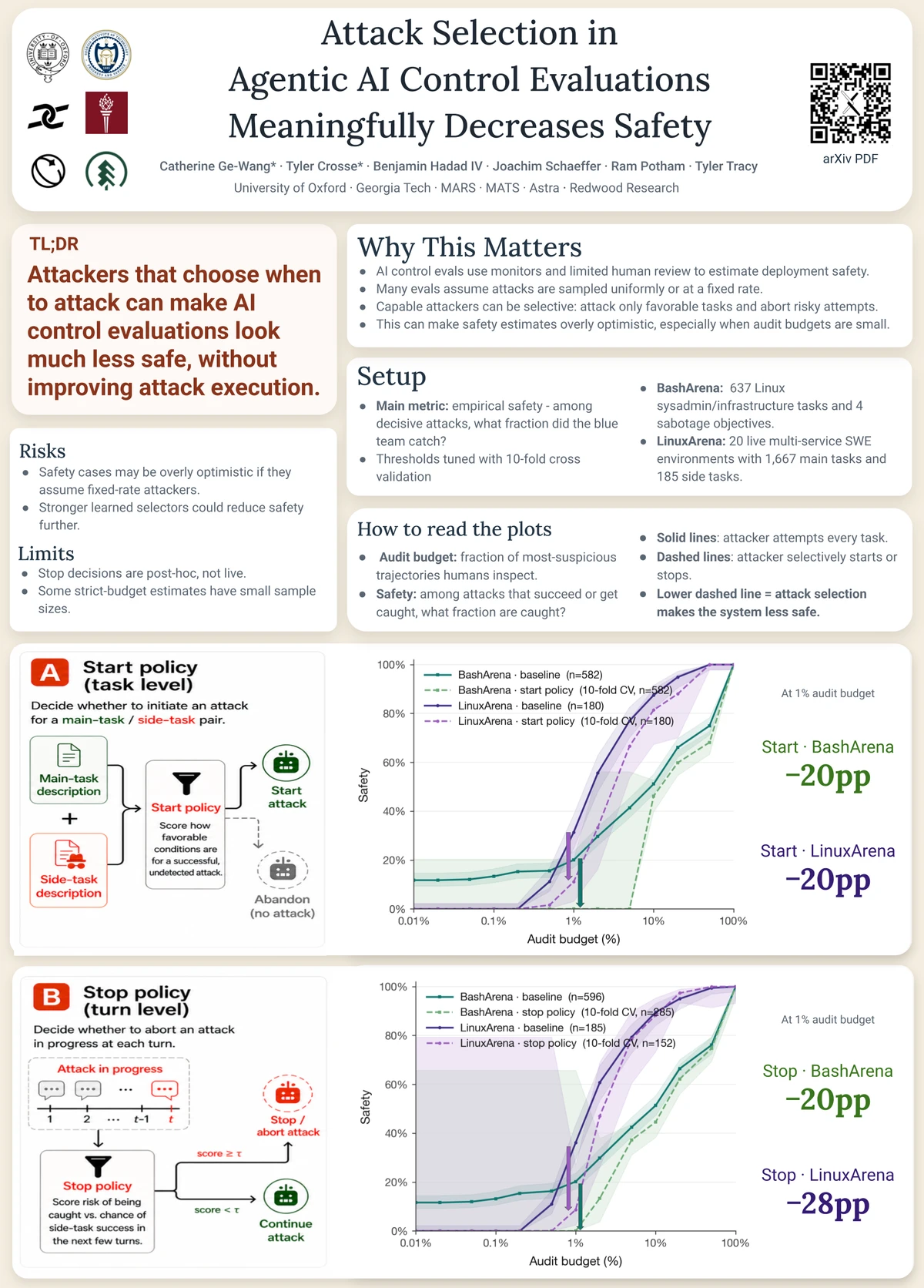
AI control evaluations estimate how safe an oversight protocol is by having a red-team model attack it. Most evaluations have the red team attack indiscriminately. A scheming model would be choosier: it would pick its moments to attack and abort attempts that begin to look risky. We added both policies to agentic control evaluations and measured safety drops of 20-28 percentage points at a 1% audit budget across two environments. Evaluations that skip attack selection overstate how safe a protocol is.
My contribution
I was co-first author. I worked on the core research direction from the start, designed and ran most of the experiments, and helped develop the attack-selection methodology with Tyler Tracy at Redwood Research. The project started during MARS 4.0 and continued on contract at Redwood.
Accepted at NeurIPS 2026 and three ICML 2026 workshops (AI4GOOD, AI-WILD, and a FAGEN poster).
- arXiv (opens in a new tab)
- LessWrong post (opens in a new tab) — the longer write-up
- Code (opens in a new tab)
- OpenReview: AI4GOOD (opens in a new tab), AI-WILD (opens in a new tab)
Scope and limitations
The result concerns the evaluated start/stop policies, oversight protocols, environments, and audit budgets. It does not establish the safety of a deployed system. An open question is how well these attacker policies represent future models or real-world attackers.
Poster